Skip to Content Skip to Footer
LiveWell WIC logo
Livewell Wic
  • Home
  • Ellyn Satter
    • Ellyn Satter
      Prenatal / Postpartum
    • Ellyn Satter
      Newborn / Infant
    • Ellyn Satter
      Older Baby / Almost Toddler
    • Ellyn Satter
      Toddler / Preschooler
  • Breastfeeding
  • Eat·Grow·Live Healthy
    • Eat·Grow·Live Healthy
      Women
    • Eat·Grow·Live Healthy
      Infants
    • Eat·Grow·Live Healthy
      Children
    • Eat·Grow·Live Healthy
      Fathers
  • Live Well Blog
  • Español
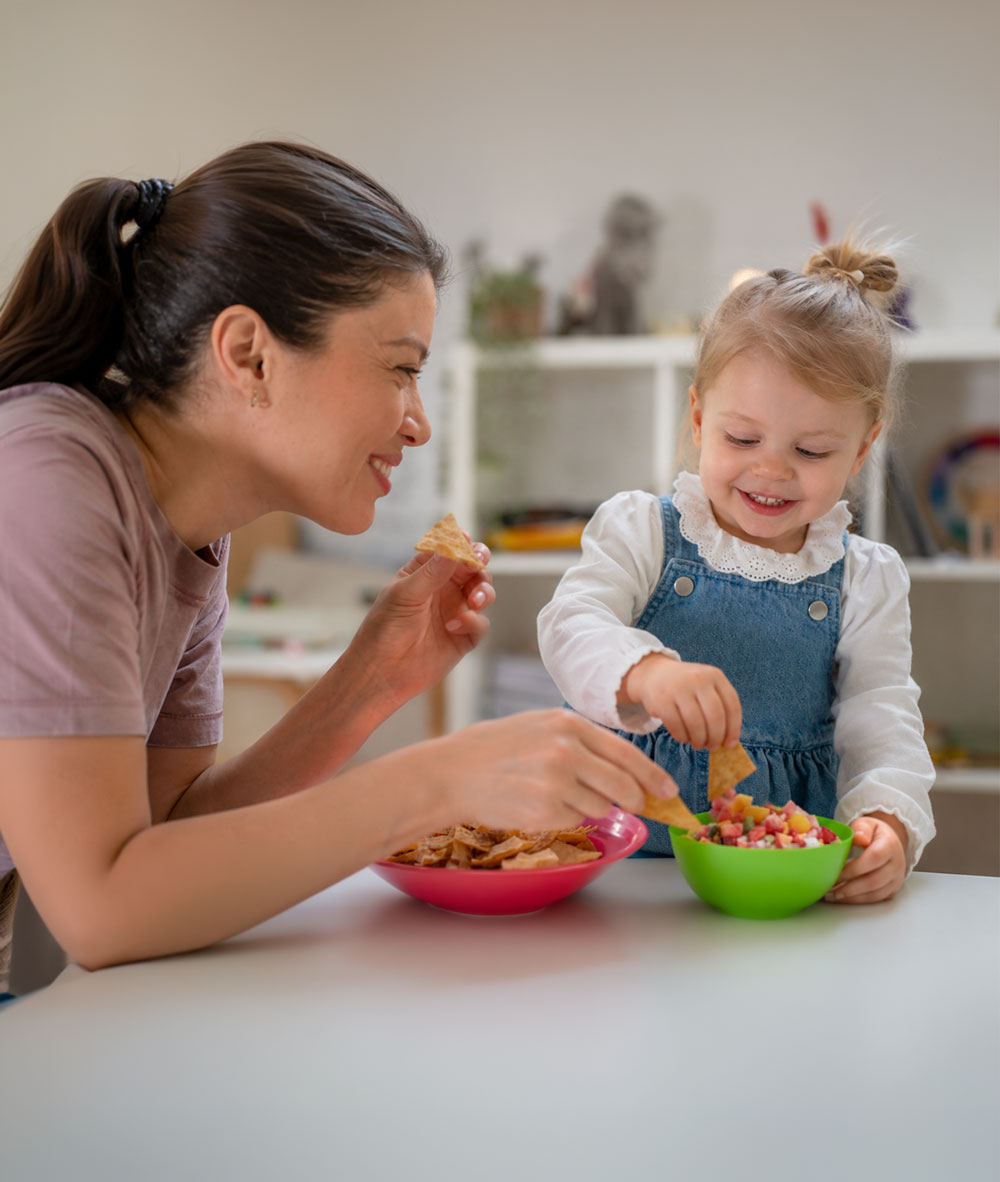
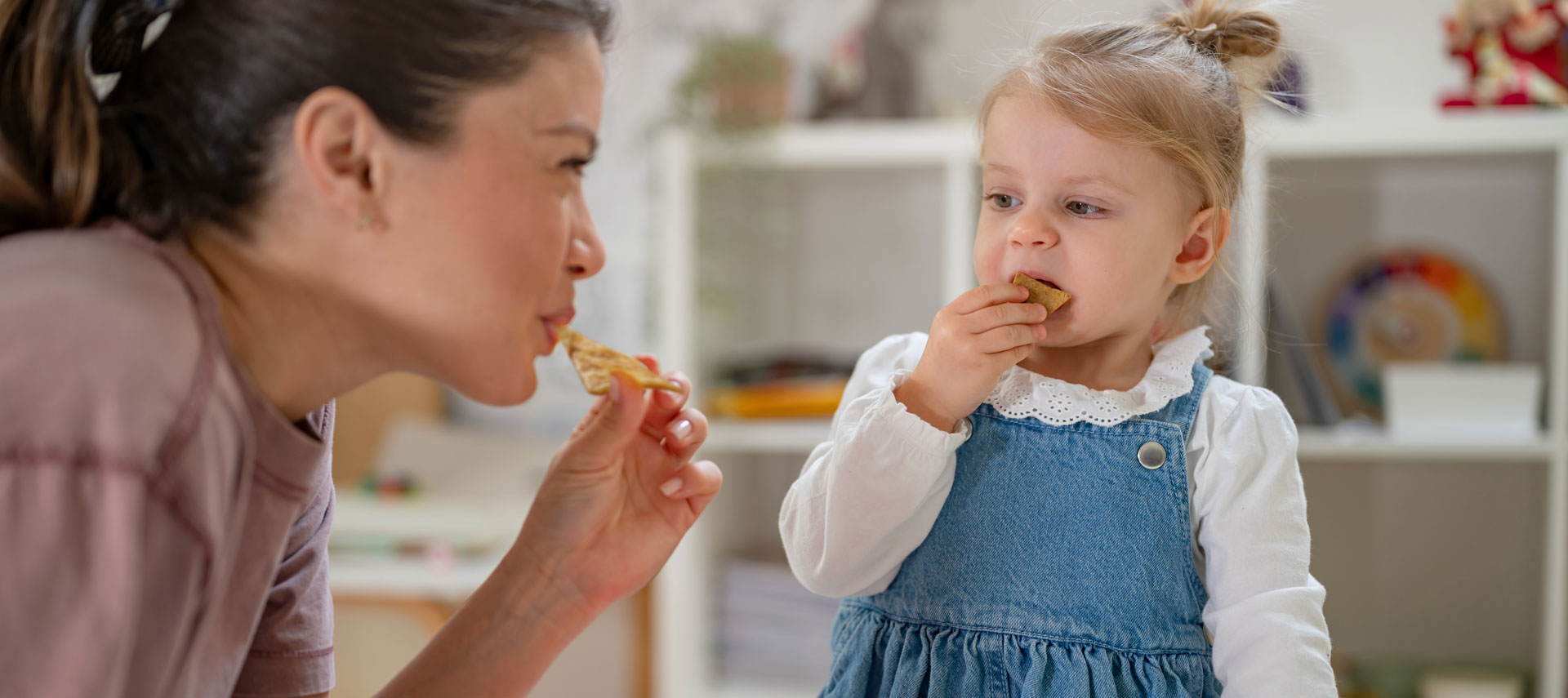
Mother and daughter eating chips together

Rainbow Fruit Salsa with Cinnamon Chips | Healthy Family Snack Recipe
  • Home
  • Live Well Blog
  • Rainbow Fruit Salsa with Cinnamon Chips | Healthy Family Snack Recipe
August 5, 2026 Recipes

dish pattern Rainbow Fruit Salsa with Cinnamon Chips

Not a fan of traditional tomato salsa?

Give this sweet and colorful fruit version a try! Rainbow Fruit Salsa is packed with vitamin C, vitamin A, and fiber. It makes a fun snack, side dish, or healthy dessert.

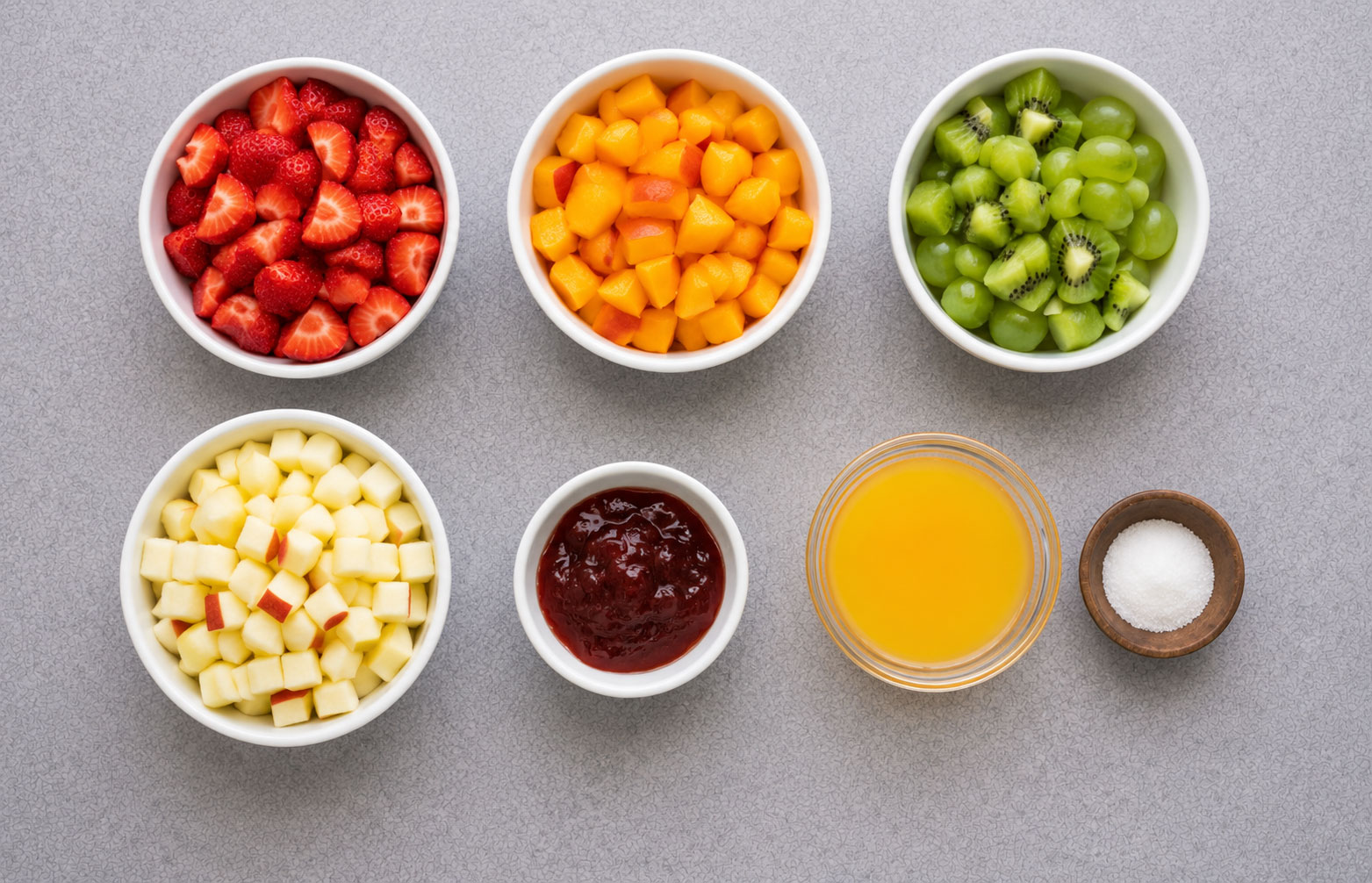
Bowls of chopped fruit and juice arranged neatly

Ingredients Fruit Salad Ingredients

  • 1 cup strawberries, fresh or frozen, chopped
  • 1 cup chopped peaches or apricots, fresh or canned
  • 1 cup of grapes or kiwi, chopped
  • 2 firm apples like Gala or Honeycrisp, peeled and chopped
  • 2 tablespoons peach, apricot, or strawberry jam
  • ½ cup orange juice
  • Sugar to taste, if needed
Tip!

You can substitute other fruits if you don’t have these!

notebook icon Fruit Salad Directions

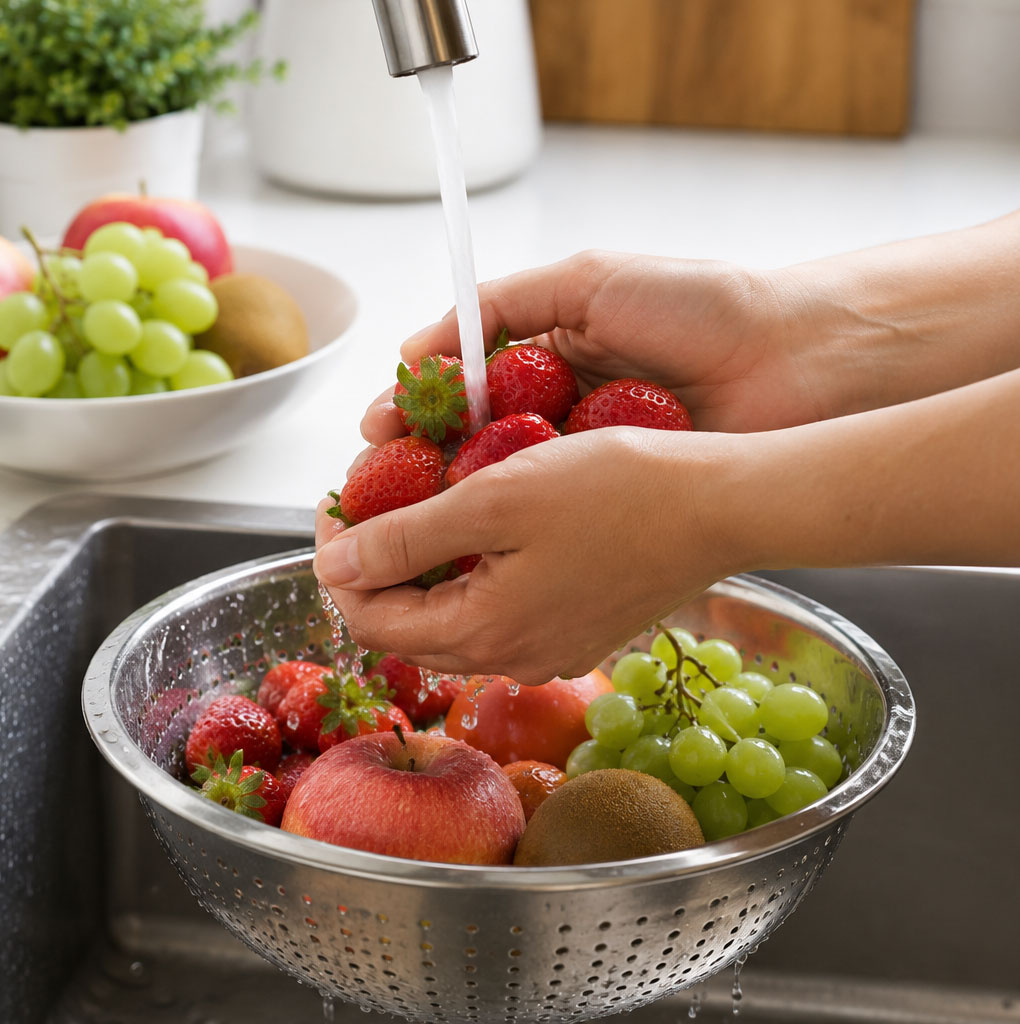
Rinsing strawberries in colander under running faucet
1.

Wash and peel fresh fruit.

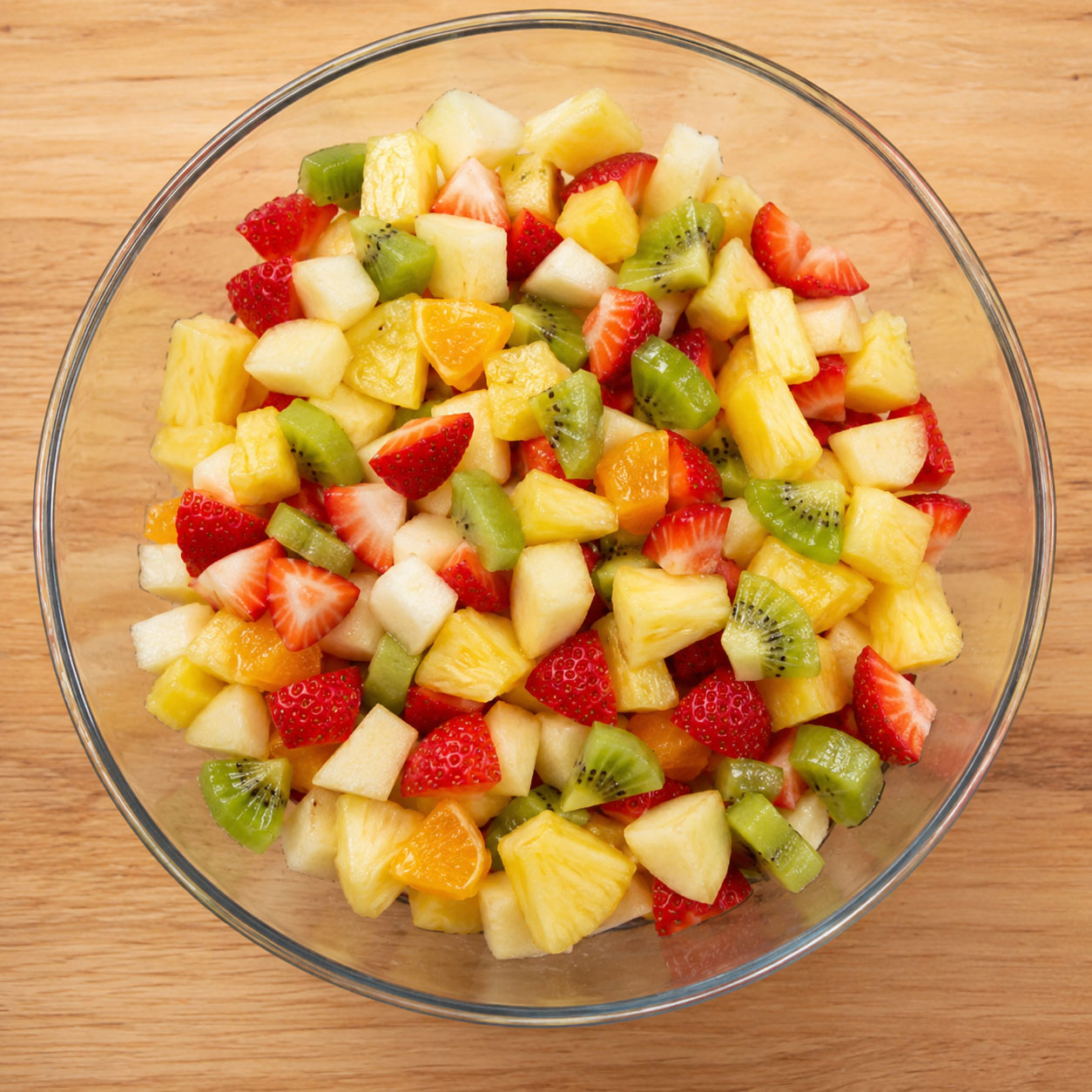
Chopped mixed fruit in glass bowl on wooden table
2.

Finely chop the fruit and place it in a large bowl. For a smoother texture, pulse the fruit a few times in a food processor until it looks like salsa.
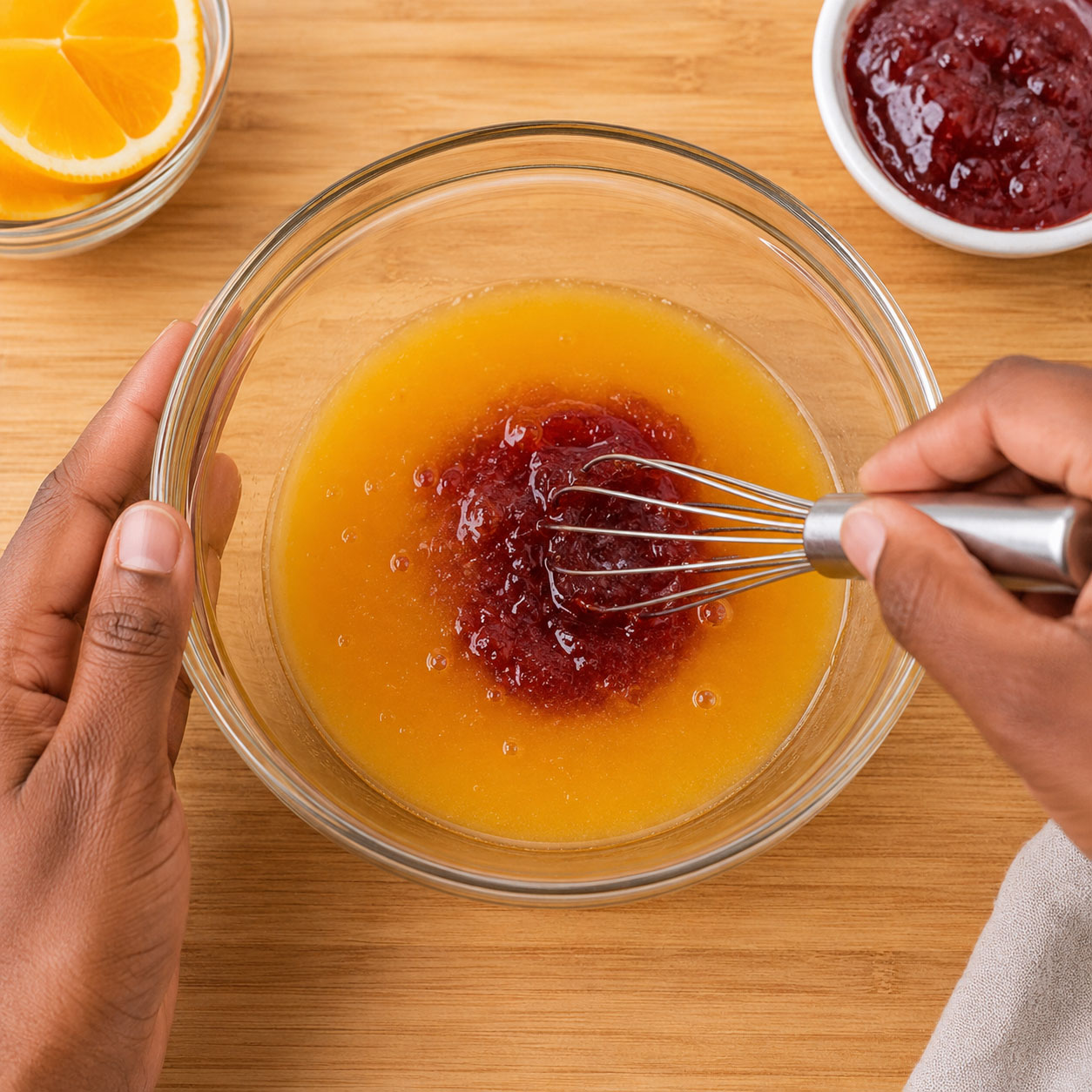
Whisk mixing fruit preserves into orange juice
3.

In a small bowl, stir together the jam and orange juice.
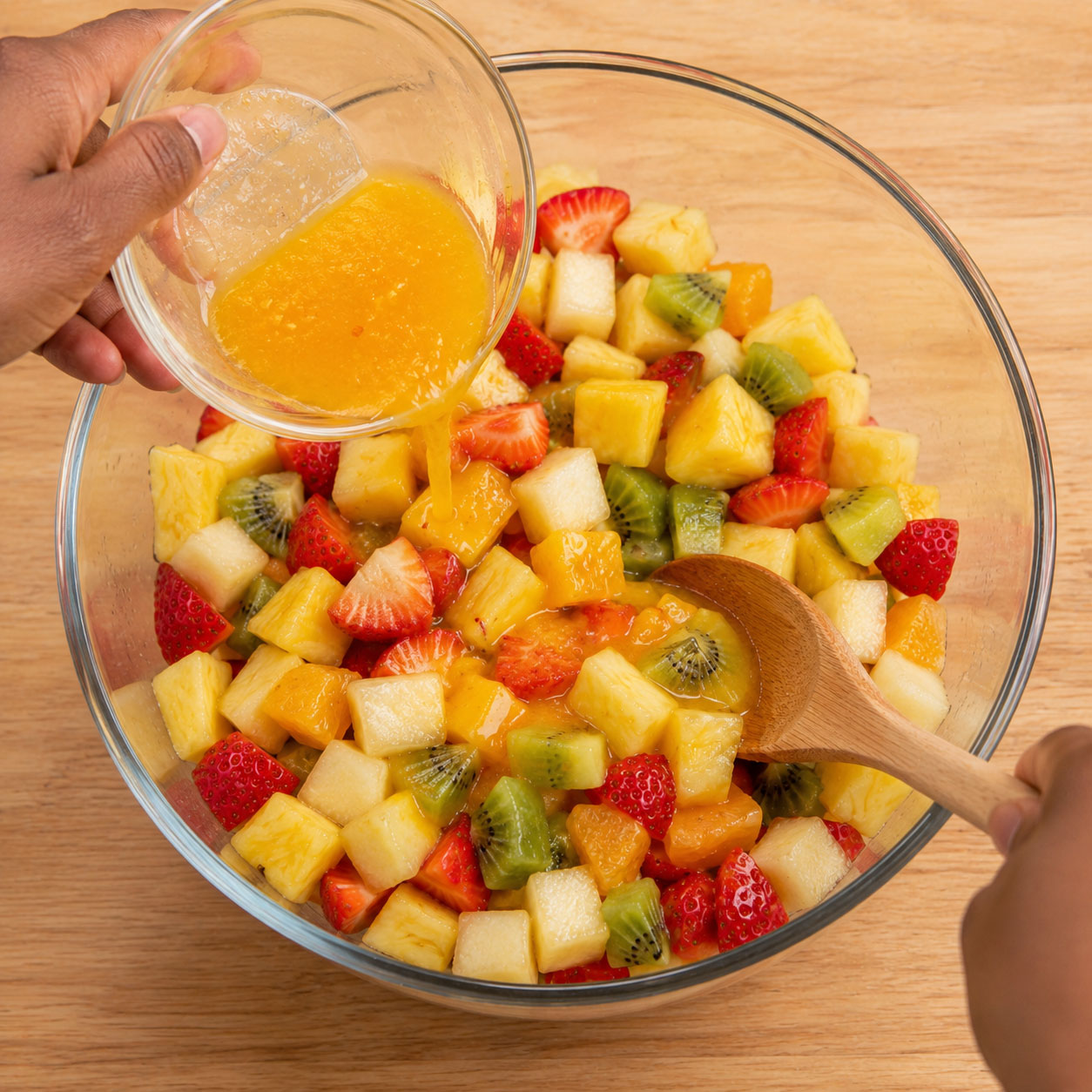
Pouring orange glaze over mixed fruit salad
4.

Pour the jam mixture over the fruit and mix well.
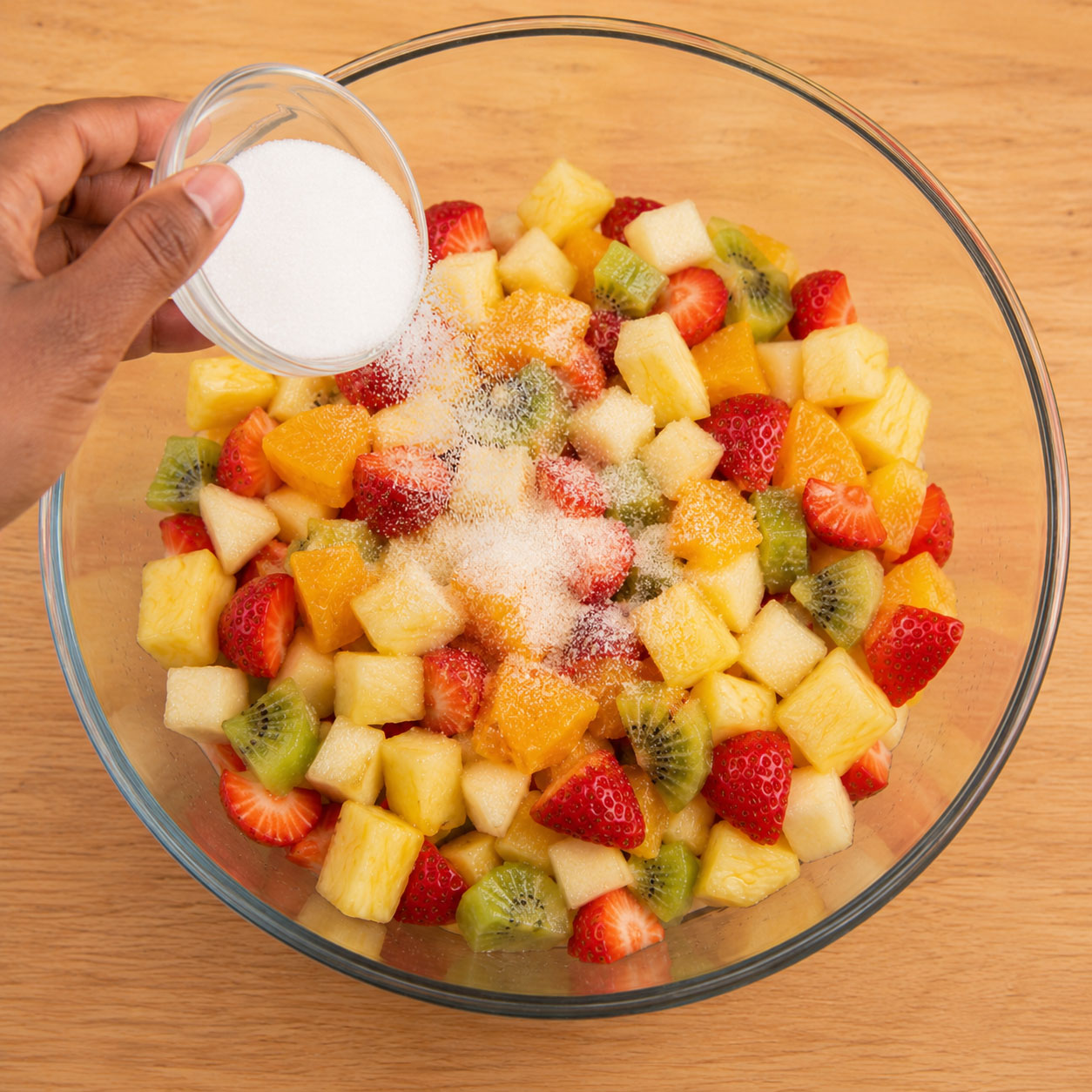
Hand sprinkling sugar onto mixed fruit salad bowl
5.

Add a small amount of sugar if needed.
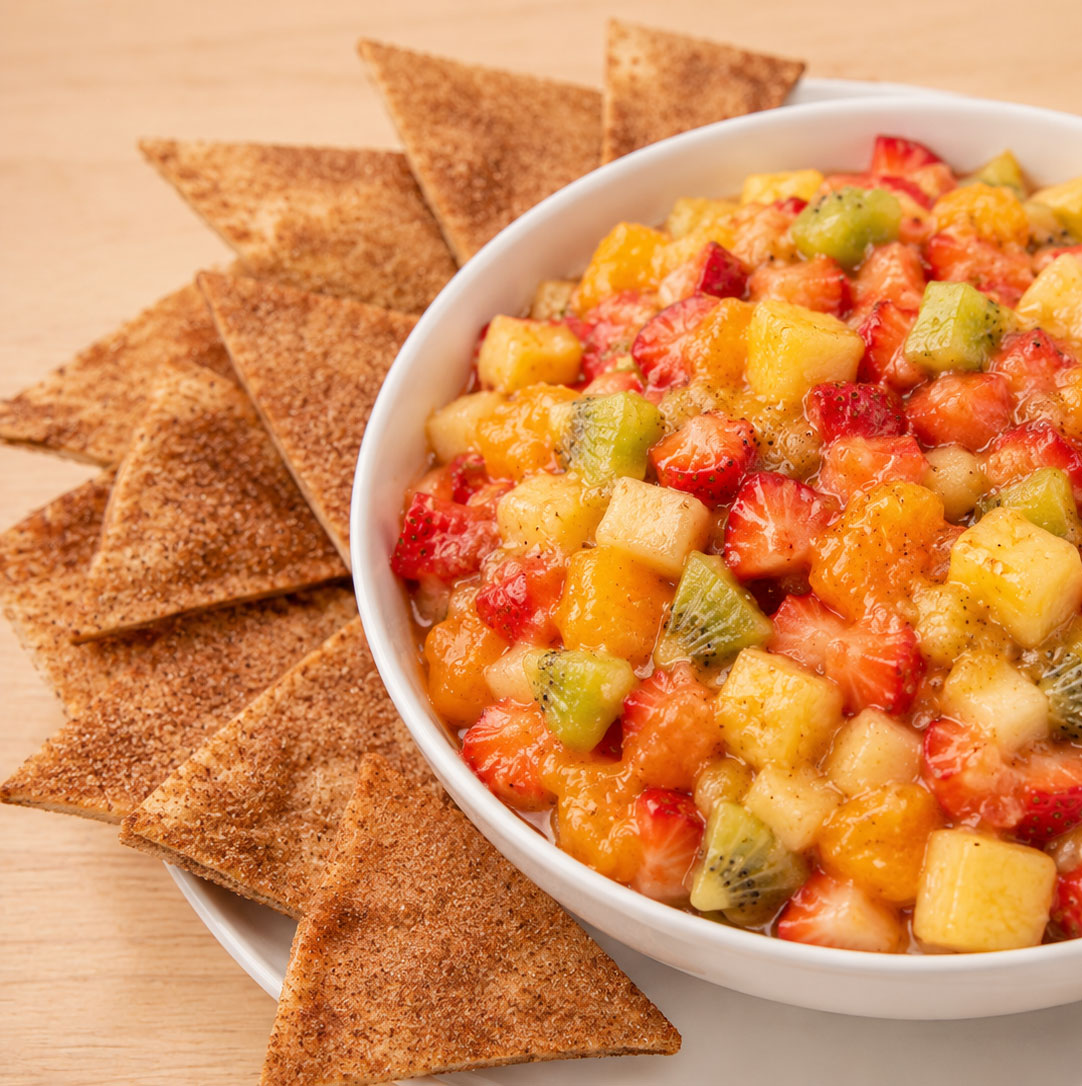
Colorful fruit salad with crispy cinnamon tortilla chips
6.

Serve with Cinnamon Tortilla Chips.

stacked rounded rectangles Cinnamon Tortilla Chips

Ingredients

  • 7 small whole wheat tortillas
  • 1 tablespoon sugar
  • ½ tablespoon cinnamon

Directions

  • Preheat oven or toaster oven to 450° F.
  • Using clean kitchen scissors or a knife, cut each tortilla into 6 wedges.
  • Place the wedges on a baking sheet or piece of aluminum foil.
  • In a small bowl, mix the cinnamon and sugar.
  • Lightly brush each tortilla wedge with water and sprinkle with the cinnamon sugar mixture.
  • Bake for about 10 minutes, or until crisp.

question Why Choose Whole Grains

The Dietary Guidelines for Americans recommend making at least half of the grains you eat whole grains.

What is a Whole Grain?
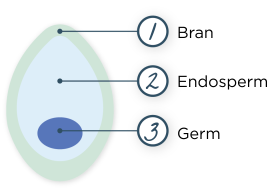
A whole grain contains all three parts of the grain:
Whole grain pattern, tileable vegetable-like motif

Refined grains usually contain only the endosperm. This removes much of the fiber and many important nutrients.

Did you know?
Common whole-grain foods include:
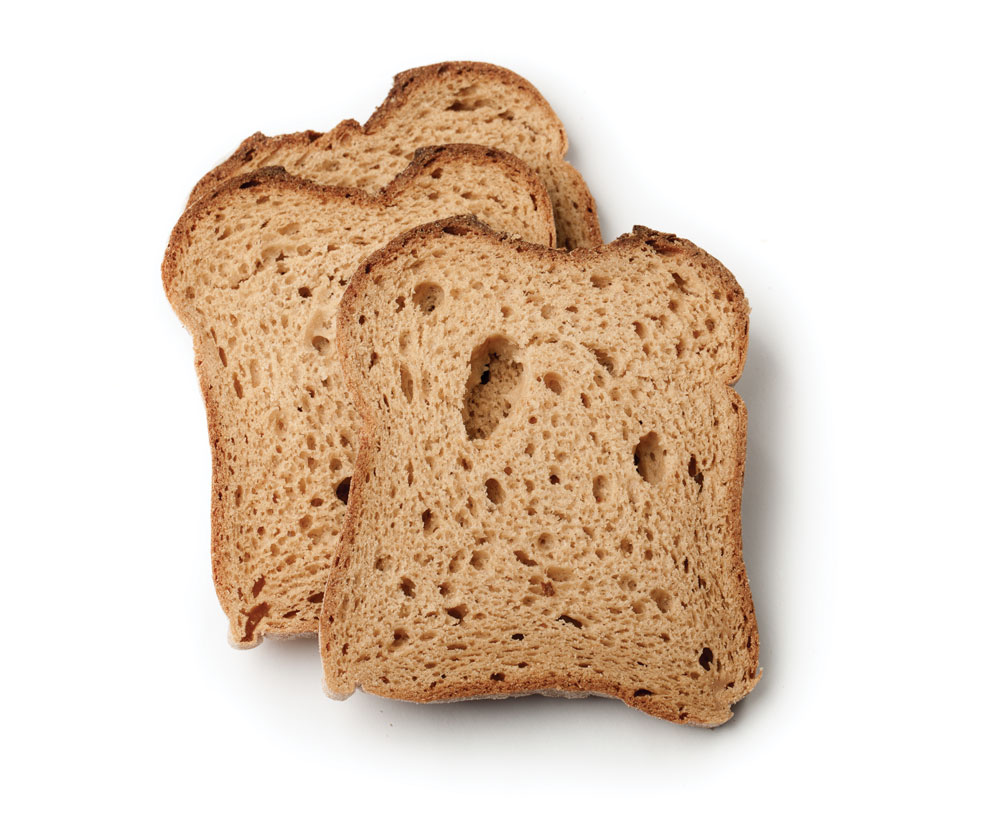
Slices of whole-grain bread on white background
Whole wheat bread
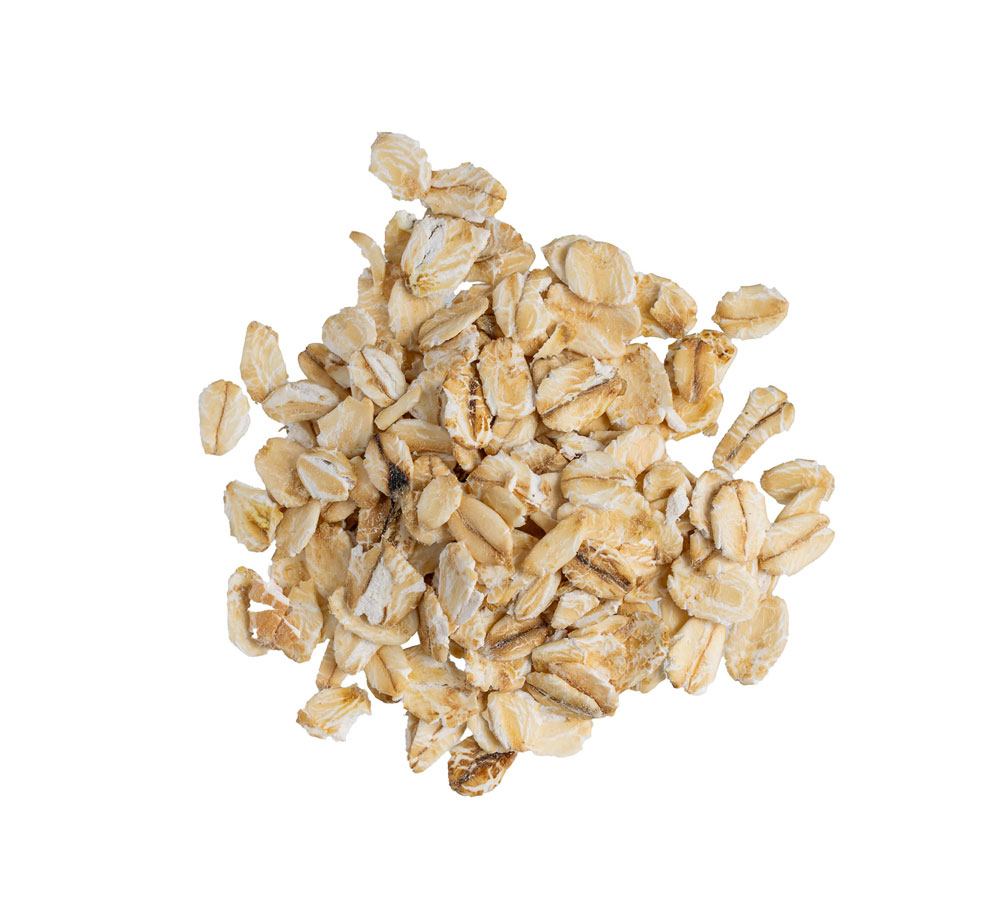
Rolled oats piled in a small heap
Oatmeal
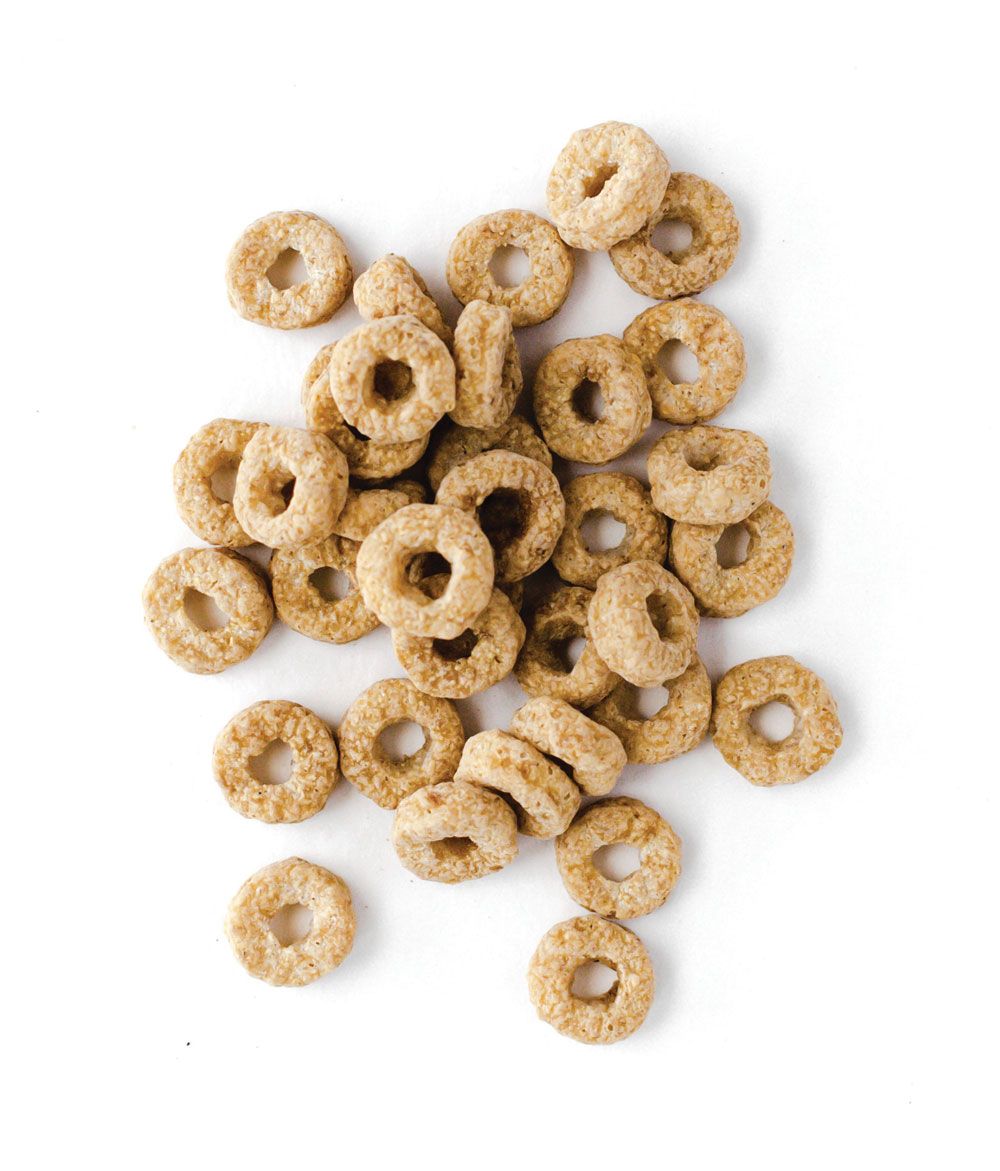
Oat ring cereal scattered on white background
Whole-grain cereal
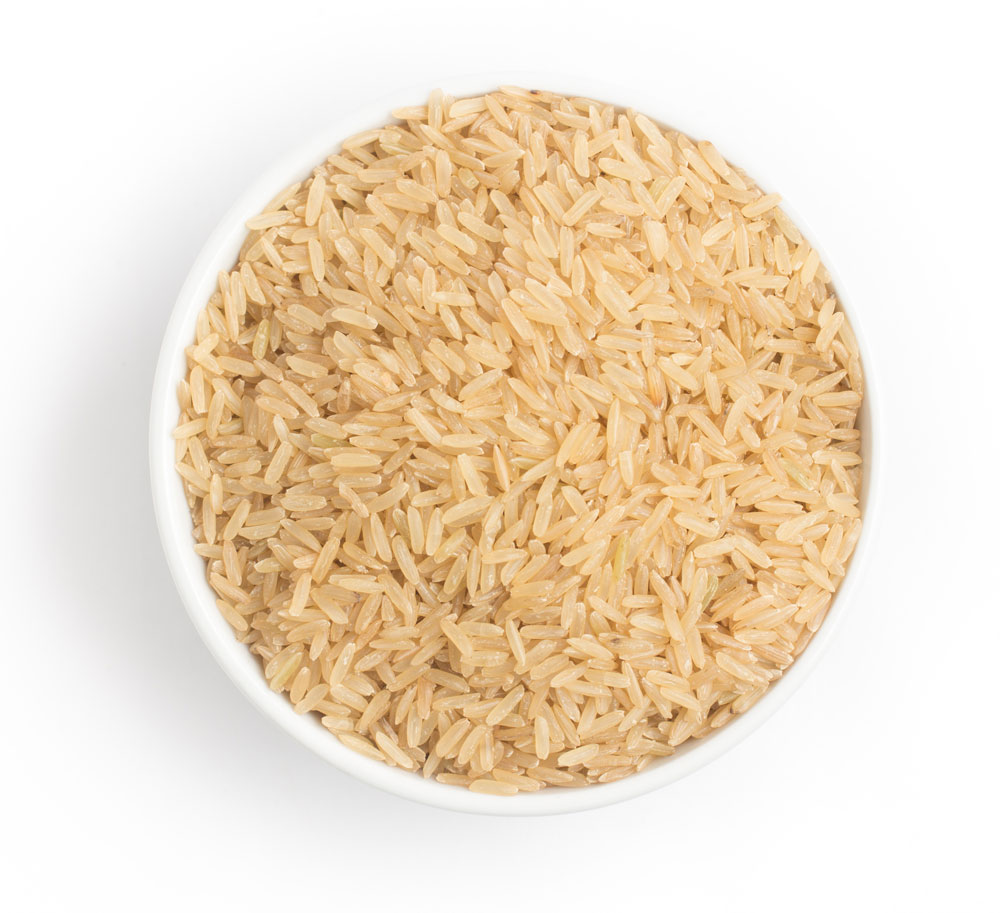
White bowl filled with raw brown rice
Brown rice
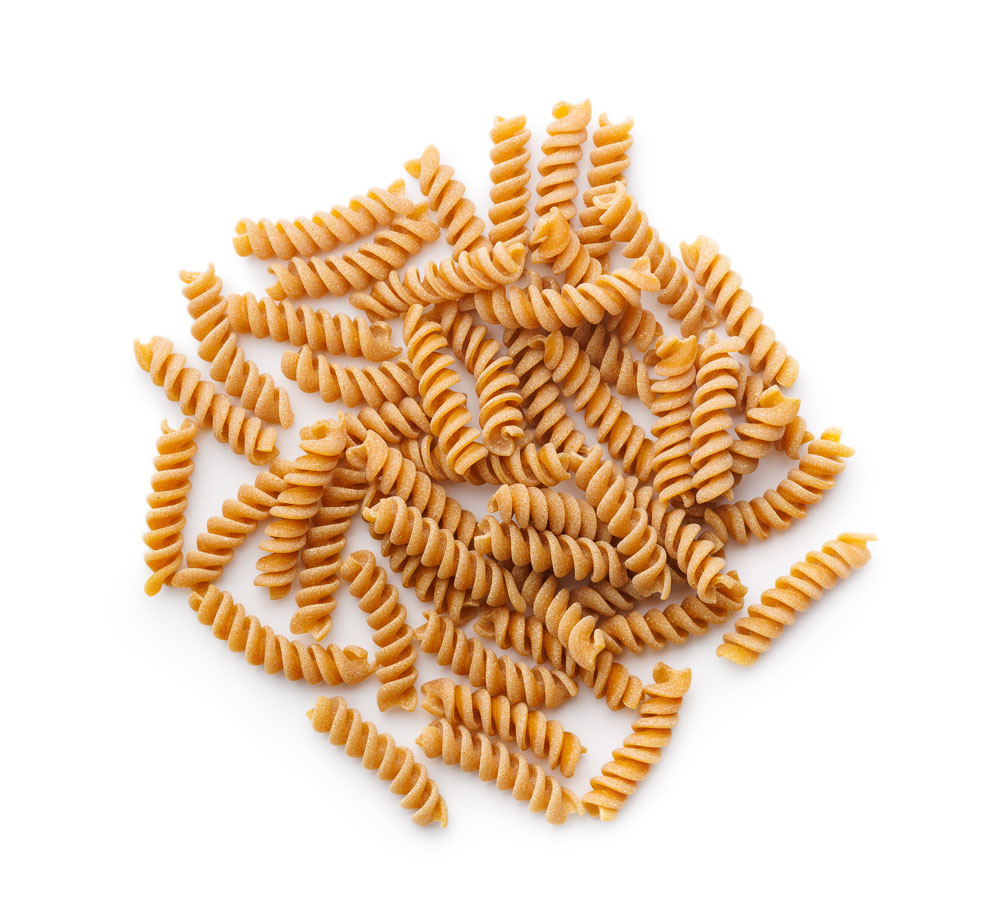
Whole wheat fusilli pasta piled on white background
Whole wheat pasta
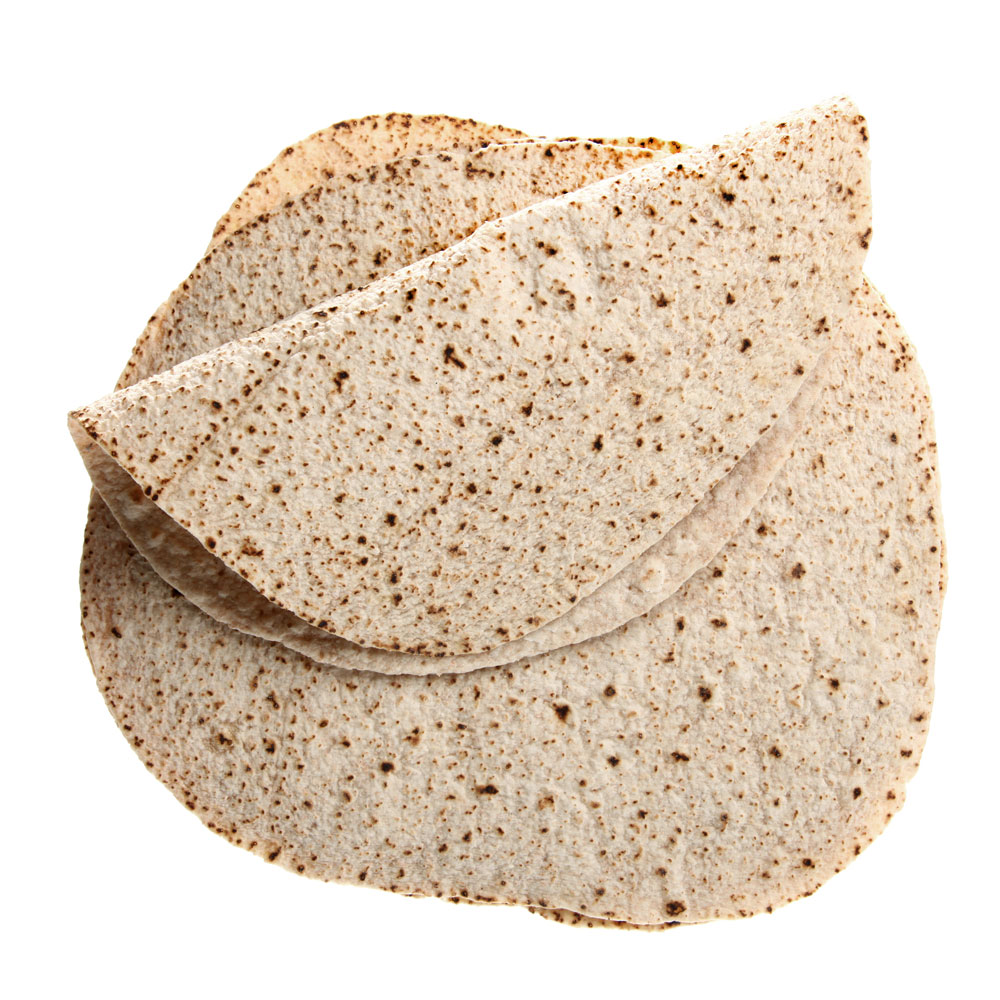
Stack of whole wheat tortillas overlapping each other
Whole wheat tortillas
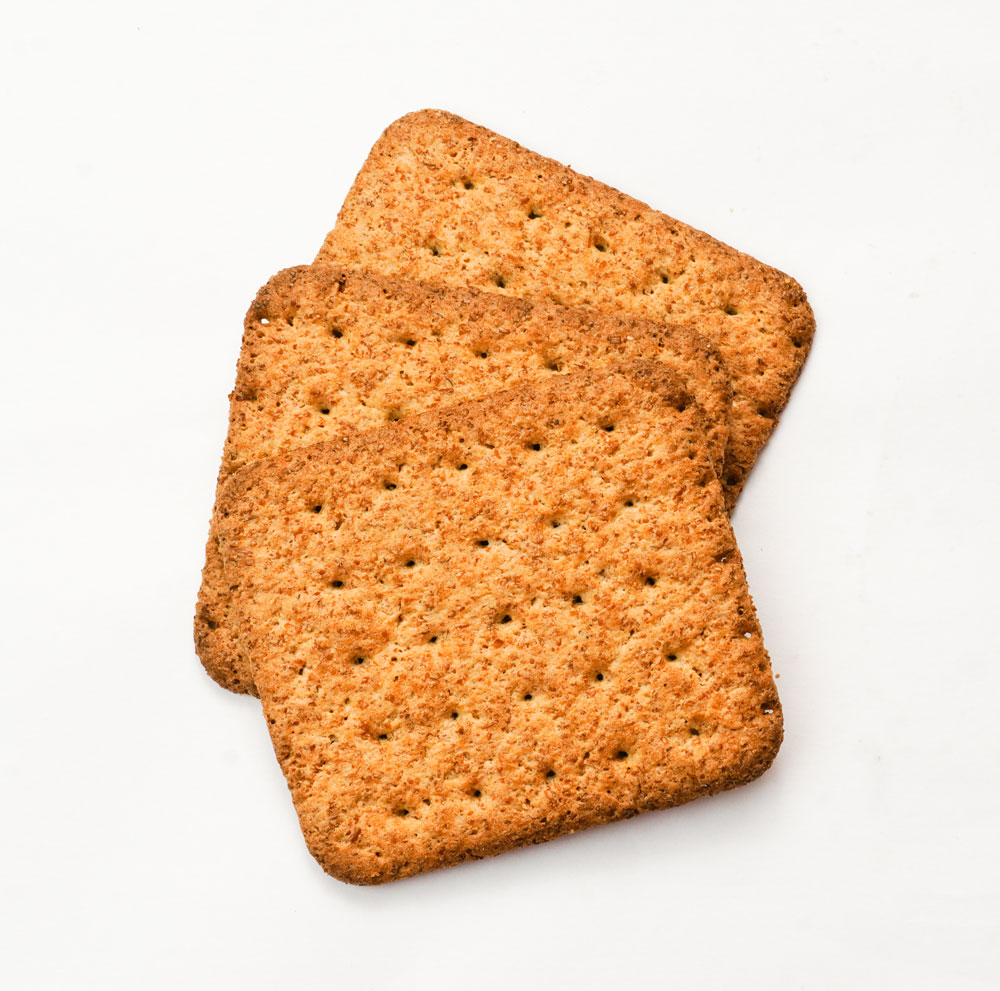
Two whole wheat crackers overlapping slightly
Whole-grain crackers
Many WIC-approved foods are whole grains, making it easier to include them in your meals and snacks.

Decorative abstract shape How Can Whole Grains Help?

Eating whole grains as part of a healthy diet may help:

  • ✓ Support heart health
  • ✓ Lower the risk of type 2 diabetes
  • ✓ Maintain healthy blood pressure
  • ✓ Reduce inflammation
  • ✓ Support a healthy weight
  • ✓ Keep your digestive system healthy

Try choosing whole-grain foods more often to help your family get the fiber and nutrients they need!

Remember!
Mother and toddler sharing chips and fruit salsa

REFERENCES:

United States Department of Agriculture. (2025). Dietary Guidelines for Americans 2020-2025 – Executive Summary.
https://www.dietaryguidelines.gov/sites/default/files/2021-03/DGA_2020-2025_ExecutiveSummary_English.pdf

Whole Grains Council. (2026). What’s a whole grain?
https://wholegrainscouncil.org/whole-grains-101/whats-whole-grain-refined-grain

Sawicki CM, Jacques PF, Lichtenstein AH, Rogers GT, Ma J, Saltzman E, McKeown NM. Whole- and Refined-Grain Consumption and Longitudinal Changes in Cardiometabolic Risk Factors in the Framingham Offspring Cohort. J Nutr. 2021 Sep 4;151(9):2790-2799. doi: 10.1093/jn/nxab177. PMID: 34255848; PMCID: PMC8417925.
https://pubmed.ncbi.nlm.nih.gov/34255848/

Tighe P, Duthie G, Vaughan N, Brittenden J, Simpson WG, Duthie S, Mutch W, Wahle K, Horgan G, Thies F. Effect of increased consumption of whole-grain foods on blood pressure and other cardiovascular risk markers in healthy middle-aged persons: a randomized controlled trial. Am J Clin Nutr. 2010 Oct;92(4):733-40. doi: 10.3945/ajcn.2010.29417. Epub 2010 Aug 4. PMID: 20685951.
http://www.ncbi.nlm.nih.gov/pubmed/20685951

Miles G., Rangan A and Grafenauer S. Whole Grain Consumption and Inflammatory Markers: A Systematic Literature Review of Randomized Control Trials. Nutrients. 2022 Jan; 14(2): 374.
https://www.ncbi.nlm.nih.gov/pmc/articles/PMC8778110/

McRae MP. Health Benefits of Dietary Whole Grains: An Umbrella Review of Meta-analyses. J Chiropr Med. 2017 Mar;16(1):10-18. doi: 10.1016/j.jcm.2016.08.008. Epub 2016 Nov 18. PMID: 28228693; PMCID: PMC5310957.
https://www.ncbi.nlm.nih.gov/pmc/articles/PMC5310957/

Author: Amanda Hojnacki

You May Also Like...

July 1, 2026

Healthy Red, White, and Blue Snacks for Kids

Red, White, and Blue Snacks Kids Will Love This July 4th July 4th is a fun time to celebrate with family, friends, and yummy food. But holiday snacks don’t have…

Read More
1
June 17, 2026

Simple Meals with Canned Fish: Easy, Healthy & Budget-Friendly Ideas

Simple Meals with Canned Fish Canned fish is a quick, easy, and affordable way to add healthy protein to your meals. Options like tuna, salmon, and sardines are packed with…

Read More
1
May 6, 2026

Fresh & Easy Spring Snacks for Toddlers

Fresh & Easy Springtime Snacks for Toddlers Spring is a great time to enjoy fresh, colorful foods. Many fruits and vegetables are in season, and they make perfect snacks for…

Read More
1
WATCH VIDEOS
  • Infant
    • Infant Pacifiers: Benefits, Safety Tips, and When to Wean
    • When to Start Peanut and Egg to Help Prevent Allergies
    • The Basics of Paced Bottle-Feeding
    • How Do I Know If My Baby Could Be Tongue-Tied?
    • Protect Your Baby from Cronobacter
  • Children
    • Simple Child Safety Tips Every Parent Should Know
    • Shopping With Kids: A Simple Way to Help Them Like More Foods
    • Pumpkin Fun: Free and Healthy Activities for Kids Under 5
    • Letting Your Child Play with Food Can Be a Good Thing
    • Is Snack Time Treat Time?
  • General /Family
    • The Benefits of Family Meals for Kids and Parents
    • Meet the Milks: Dairy and Plant-Based Choices
    • Avoiding Food Waste
    • The 2025-2030 Dietary Guidelines for Americans – What Families Need to Know
    • Finding Calm When Life Gets Busy: Stress-Management for Parents
  • Women
    • Breastfeeding Support Available Through WIC | Pumps, Peer Counselors & More
    • How Partners Can Support Breastfeeding
    • Common Breastfeeding Challenges and Simple Solutions for Parents
    • Paced Bottle-Feeding: How to Feed Your Baby the Right Way
    • Breastfeeding and Returning to Work: Tips for Pumping & Planning
  • Recipes
    • Healthy Red, White, and Blue Snacks for Kids
    • Simple Meals with Canned Fish: Easy, Healthy & Budget-Friendly Ideas
    • Fresh & Easy Spring Snacks for Toddlers
    • Fresh & Easy Spring Veggie Pasta
    • Heart-Healthy Recipe: Banana Berry Oatmeal Cups
LiveWell WIC program logo

Contact Us

USDA is an equal opportunity provider, employer, and lender.

Cookie PolicyAbout UsPrivacy PolicyTerms of Agreement

© Brush Art Corporation

Share

  • Email
  • SMS
If you are using multiple emails, separate them with commas.

    SMS Communication Consent

    Share to Social

    Share this link via

    Cartoon vegetables with leafy tops gather playfully together.

    Side-Lying Hold

    1. For the right breast, lie on your right side with your baby facing you.
    2. Pull your baby close. Your baby’s mouth should be level with your nipple.
    3. In this position, you can cradle your baby’s back with your left arm and support yourself with your right arm and/or pillows.
    4. Keep loose clothing and bedding away from your baby.
    5. Reverse for the left breast.

    This hold is useful when:

    • You had a C-section
    • You want to rest while baby feeds
    • You are breastfeeding in the middle of the night
    • You and your baby are comfortable in this position
    Yellow circle with abstract, jagged shapes and patterns.

    Cross-Cradle Hold

    1. For the right breast, use your left arm to hold your baby’s head at your right breast and baby’s body toward your left side. A pillow across your lap can help support your left arm.
    2. Gently place your left hand behind your baby’s ears and neck, with your thumb and index finger behind each ear and your palm between baby’s shoulder blades. Turn your baby’s body toward yours so your tummies are touching.
    3. Hold your breast as if you are squeezing a sandwich. To protect your back, avoid leaning down to your baby. Instead, bring your baby to you.
    4. As your baby’s mouth opens, push gently with your left palm on baby’s head to help them latch on. Make sure you keep your fingers out of the way.
    5. Reverse for the left breast.

    This hold is useful when:

    • Your baby is premature
    • Your baby has a weak suck
    • Your baby needs help to stay latched
    • Your baby needs extra head support
    • You and your baby are comfortable in this position
    Cat playing with butterfly in a garden.

    Clutch or “Football” Hold

    1. For the right breast, hold your baby level, facing up, at your right side.
    2. Put your baby’s head near your right nipple and support their back and legs under your right arm.
    3. Hold the base of your baby’s head with your right palm. A pillow underneath your right arm can help support your baby’s weight.
    4. To protect your back, avoid leaning down to your baby. Bring baby to you instead.
    5. Reverse for the left breast.

    This hold is useful when:

    • You had a C-section
    • You have large breasts
    • You have flat or inverted nipples
    • You have a strong milk let-down
    • You are breastfeeding twins
    • Your baby likes to feed in an upright position
    • Your baby has reflux
    • You and your baby are comfortable in this position
    Peach circle with abstract shapes radiating outward.

    Cradle Hold

    1. For the right breast, cradle your baby with your right arm. Your baby will be on their left side across your lap, facing you at nipple level.
    2. Your baby’s head will rest on your right forearm with your baby’s back along your inner arm and palm.
    3. Turn your baby’s tummy toward your tummy. Your left hand is free to support your breast, if needed. Pillows can help support your arm and elbow.
    4. To protect your back, avoid leaning down to your baby. Instead, bring your baby to you.
    5. Reverse for the left breast.

    This hold is useful when:

    • Your baby needs help latching on
    • You and your baby are comfortable in this position
    Smiling peach character waving cheerful hello.

    Laid-Back Hold

    1. Lean back on a pillow with your baby’s tummy touching yours and their head at breast level. Some moms find that sitting up nearly straight works well. Others prefer to lean back and lie almost flat.
    2. You can place your baby’s cheek near your breast, or you may want to use one hand to hold your breast near your baby. It’s up to you and what you think feels best.
    3. Your baby will naturally find your nipple, latch, and begin to suckle.

    This hold is useful when:

    • Your baby is placed on your chest right after birth
    • You have a strong milk let-down
    • You have large breasts
    • You and your baby are comfortable in this position