Skip to Content Skip to Footer
LiveWell WIC logo
Livewell Wic
  • Home
  • Ellyn Satter
    • Ellyn Satter
      Prenatal / Postpartum
    • Ellyn Satter
      Newborn / Infant
    • Ellyn Satter
      Older Baby / Almost Toddler
    • Ellyn Satter
      Toddler / Preschooler
  • Breastfeeding
  • Eat·Grow·Live Healthy
    • Eat·Grow·Live Healthy
      Women
    • Eat·Grow·Live Healthy
      Infants
    • Eat·Grow·Live Healthy
      Children
    • Eat·Grow·Live Healthy
      Fathers
  • Content Suite
  • Español
Father feeding baby with a bottle on the couch

Weaning from Breastfeeding: When You and Your Child Are Ready

  • Home
  • Content Suite
  • Weaning from Breastfeeding: When You and Your Child Are Ready
October 28, 2026 Women

breastfeeding Weaning from Breastfeeding: When You and Your Child Are Ready

Breastfeeding is a journey, and every journey looks different. Some parents know when they are ready to stop. Some children slowly lose interest. Sometimes a family needs to wean sooner than planned.

There is no perfect timeline.

Breast milk continues to provide nutrition and other benefits after a child’s first birthday. Families can continue breastfeeding through age 2 or beyond, as long as it works for both the parent and child. When it’s time to wean, a slow and flexible plan can help make the change easier.

White daisies with pale blue petals overlapping
Two illustrated daisies with yellow centers
Colorful abstract design with diagonal pattern and stripes

question Is Your Child Weaning – or Is It a Nursing Strike?

Child-led weaning usually happens slowly. You may notice that your child:

  • Asks to breastfeed less often.
  • Breastfeeds for a shorter time.
  • Sometimes turns away when you offer the breast.
  • Chooses food, a cup, playtime, or cuddles instead.

A sudden refusal is different. If a baby younger than 1 year suddenly stops breastfeeding, it may be a nursing strike. Illness, teething, stress, or a change in routine can sometimes lead to a nursing strike. It doesn’t always mean your baby is ready to stop breastfeeding.

Woman doctor profile photo

WIC breastfeeding staff or a lactation consultant can help you look for the cause and make a feeding plan. If your baby is not taking enough milk, has fewer wet diapers, or seems very sleepy or sick, contact your baby’s healthcare provider.

What Does Your Child Need as Breastfeeding Decreases?

Most babies are ready to begin solid foods around 6 months.
At first, these foods are offered in addition to breast milk or infant formula. They do not replace all milk feedings. Breast milk or iron-fortified infant formula remains an important source of nutrition throughout the first year.

Before 12 months:

Mother bottle-feeding her baby

If your baby stops receiving breast milk, offer iron-fortified infant formula in its place. Cow’s milk and plant-based drinks shouldn’t replace breast milk or infant formula during the first year.
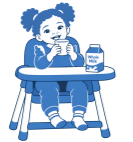
At 12 months or older:

Toddler in a high chair icon

Plain, pasteurized whole cow’s milk may be offered in a cup. If your child cannot have cow’s milk or your family does not use dairy, ask WIC staff or your child’s healthcare provider which fortified, unsweetened alternative is right for your child.


Tip!

Breast milk does not lose its value after age 1. It can remain part of your child’s diet while meals, snacks and family foods take on a larger role.

Healthy food icon, stylized fruits and vegetables
Mother breastfeeding baby while sitting on couch
Remember!

Early morning, nap, and bedtime feedings may be the hardest for a child to give up. It’s okay to save those for last. If you need to stop breastfeeding quickly, ask a healthcare provider or lactation specialist for help making a safe plan.

nots Take It One Feeding at a Time

Planned weaning often takes several weeks or longer. There is no schedule that works for every family. These steps can help your body and your child adjust:

1.

Choose the breastfeeding session your child seems least interested in.

2.

Shorten that session or skip it. If you pump, shorten or remove one pumping session.

3.

Wait several days, or until your breasts feel comfortable, before making another change.

4.
Offer extra comfort, such as cuddles, a book, a snack, a cup or playtime.

herat Help Your Body Adjust

As milk is removed less often, your body will slowly begin to make less. Gradual weaning can lower the chance of engorgement, plugged ducts, and mastitis.
discomfort icon

Use a wrapped cold pack to help with swelling or discomfort.

Two milk bottles connected to a box, representing a breast

Wear a comfortable, supportive bra that is not too tight.

Digital stethoscope emitting sound waves, connected to device

If your breasts feel very full, hand express or pump only enough milk to feel comfortable. Removing more milk than you need for comfort can tell your body to keep making it.

Tip!
Contact your healthcare provider if you have worsening breast pain or redness, fever, chills, or flu-like symptoms.
Mother kissing babys hand while breastfeeding

hand heart Feelings Are Part of It, Too

Weaning can bring many feelings. You may feel proud, sad, relieved, or unsure. You may feel several of these things at once. Hormone changes and the emotions that come with this transition may both play a role.

Remember!

Give yourself time and ask people you trust for support. If sadness or anxiety feels strong, lasts, or makes daily life hard, contact your healthcare provider.

healthy people WIC Is Here for You

You don’t have to figure out weaning alone. WIC breastfeeding staff can help you tell the difference between gradual weaning and a nursing strike, plan your baby’s feedings, manage breast discomfort and find more help when needed.

Whether breastfeeding continues or comes to an end, the goal is the same: a healthy child and a parent who feels informed, respected, and supported.

REFERENCES:

Centers for Disease Control and Prevention. (2026, April 16). Weaning From Breastfeeding.
https://www.cdc.gov/infant-toddler-nutrition/breastfeeding/weaning.html

United States Department of Agriculture. WIC Breastfeeding Support. (2026).Weaning Your Baby.
https://wicbreastfeeding.fns.usda.gov/weaning-your-baby

United States Department of Agriculture. WIC Breastfeeding Support. (2026).Why Baby May Suddenly Refuse the Breast.
https://wicbreastfeeding.fns.usda.gov/why-baby-may-suddenly-refuse-breast

United States Department of Agriculture. WIC Breastfeeding Support. (2026). Plugged Ducts, Mastitis, and Thrush.
https://wicbreastfeeding.fns.usda.gov/plugged-ducts-mastitis-and-thrush

Do you find this Blog helpful?

Show some love here!

SMS Communication Consent

No comments yet. Be the first to share your thoughts!

Scroll To Top

You May Also Like...

October 21, 2026

Postpartum Psychosis: Signs and Where to Get Help

Postpartum Psychosis: Know the Signs and Get Help Having a baby can bring many changes. It’s common to feel tired, worried, or overwhelmed at times. But sudden changes in a…

Read More
3
0
September 30, 2026

Breastfeeding After a C-Section: Tips for WIC Moms

If you just had a C-section, or are planning to have one, you might be wondering: Can I still breastfeed my baby? The answer is a big YES! While recovering…

Read More
3
0
August 26, 2026

Breastfeeding Nipple Pain: What’s Normal and When to Get Help

Many new parents are told that breastfeeding is supposed to hurt at first. You may even hear that you just have to “push through the pain.” The truth is, breastfeeding…

Read More
4
0
WATCH VIDEOS
  • Infant
    • Infant Pacifiers: Benefits, Safety Tips, and When to Wean
    • When to Start Peanut and Egg to Help Prevent Allergies
    • The Basics of Paced Bottle-Feeding
    • How Do I Know If My Baby Could Be Tongue-Tied?
    • Protect Your Baby from Cronobacter
  • Children
    • Food, Feelings, and Your Child’s Health | How Nutrition Affects Mood
    • Simple Child Safety Tips Every Parent Should Know
    • Shopping With Kids: A Simple Way to Help Them Like More Foods
    • Pumpkin Fun: Free and Healthy Activities for Kids Under 5
    • Letting Your Child Play with Food Can Be a Good Thing
  • General /Family
    • Kid-Friendly Apple Cinnamon Oat Cups | WIC Recipe
    • Protecting Your Family from Cyclospora: Summer Food & Water Safety
    • The Benefits of Family Meals for Kids and Parents
    • Meet the Milks: Dairy and Plant-Based Choices
    • Avoiding Food Waste
  • Women
    • Postpartum Psychosis: Signs and Where to Get Help
    • Breastfeeding After a C-Section: Tips for WIC Moms
    • Breastfeeding Nipple Pain: What’s Normal and When to Get Help
    • Cluster Feeding Explained | WIC Breastfeeding Support
    • Breastfeeding Support Available Through WIC | Pumps, Peer Counselors & More
  • Recipes
    • Boo-Berry Yogurt Cups: Easy Halloween Snack for Kids
    • Rainbow Fruit Salsa with Cinnamon Chips | Healthy Family Snack Recipe
    • Healthy Red, White, and Blue Snacks for Kids
    • Simple Meals with Canned Fish: Easy, Healthy & Budget-Friendly Ideas
    • Fresh & Easy Spring Snacks for Toddlers
LiveWell WIC program logo

Contact Us

USDA is an equal opportunity provider, employer, and lender.

Cookie PolicyAbout UsPrivacy PolicyTerms of Agreement

© Brush Art Corporation

Share to Social

Share this link via

Share

  • Email
  • SMS
If you are using multiple emails, separate them with commas.

    Cartoon vegetables with leafy tops gather playfully together.

    Side-Lying Hold

    1. For the right breast, lie on your right side with your baby facing you.
    2. Pull your baby close. Your baby’s mouth should be level with your nipple.
    3. In this position, you can cradle your baby’s back with your left arm and support yourself with your right arm and/or pillows.
    4. Keep loose clothing and bedding away from your baby.
    5. Reverse for the left breast.

    This hold is useful when:

    • You had a C-section
    • You want to rest while baby feeds
    • You are breastfeeding in the middle of the night
    • You and your baby are comfortable in this position
    Yellow circle with abstract, jagged shapes and patterns.

    Cross-Cradle Hold

    1. For the right breast, use your left arm to hold your baby’s head at your right breast and baby’s body toward your left side. A pillow across your lap can help support your left arm.
    2. Gently place your left hand behind your baby’s ears and neck, with your thumb and index finger behind each ear and your palm between baby’s shoulder blades. Turn your baby’s body toward yours so your tummies are touching.
    3. Hold your breast as if you are squeezing a sandwich. To protect your back, avoid leaning down to your baby. Instead, bring your baby to you.
    4. As your baby’s mouth opens, push gently with your left palm on baby’s head to help them latch on. Make sure you keep your fingers out of the way.
    5. Reverse for the left breast.

    This hold is useful when:

    • Your baby is premature
    • Your baby has a weak suck
    • Your baby needs help to stay latched
    • Your baby needs extra head support
    • You and your baby are comfortable in this position
    Cat playing with butterfly in a garden.

    Clutch or “Football” Hold

    1. For the right breast, hold your baby level, facing up, at your right side.
    2. Put your baby’s head near your right nipple and support their back and legs under your right arm.
    3. Hold the base of your baby’s head with your right palm. A pillow underneath your right arm can help support your baby’s weight.
    4. To protect your back, avoid leaning down to your baby. Bring baby to you instead.
    5. Reverse for the left breast.

    This hold is useful when:

    • You had a C-section
    • You have large breasts
    • You have flat or inverted nipples
    • You have a strong milk let-down
    • You are breastfeeding twins
    • Your baby likes to feed in an upright position
    • Your baby has reflux
    • You and your baby are comfortable in this position
    Peach circle with abstract shapes radiating outward.

    Cradle Hold

    1. For the right breast, cradle your baby with your right arm. Your baby will be on their left side across your lap, facing you at nipple level.
    2. Your baby’s head will rest on your right forearm with your baby’s back along your inner arm and palm.
    3. Turn your baby’s tummy toward your tummy. Your left hand is free to support your breast, if needed. Pillows can help support your arm and elbow.
    4. To protect your back, avoid leaning down to your baby. Instead, bring your baby to you.
    5. Reverse for the left breast.

    This hold is useful when:

    • Your baby needs help latching on
    • You and your baby are comfortable in this position
    Smiling peach character waving cheerful hello.

    Laid-Back Hold

    1. Lean back on a pillow with your baby’s tummy touching yours and their head at breast level. Some moms find that sitting up nearly straight works well. Others prefer to lean back and lie almost flat.
    2. You can place your baby’s cheek near your breast, or you may want to use one hand to hold your breast near your baby. It’s up to you and what you think feels best.
    3. Your baby will naturally find your nipple, latch, and begin to suckle.

    This hold is useful when:

    • Your baby is placed on your chest right after birth
    • You have a strong milk let-down
    • You have large breasts
    • You and your baby are comfortable in this position